Subliminal Poetry
Fragments of thought caught in charcoal shadows, whispering ember secrets.


K.S. Lapham works in language as others work in light or stone—removing as much as possible until only the essential remains. His practice centers on what he describes as subliminal poetry: compressed fragments of thought that unfold gradually, often revealing themselves in layers rather than statements.
The work resists immediacy. Meaning is not delivered; it is encountered.
Each piece exists in a state of tension between presence and absence—words appear sparse, yet carry a density that invites return. What is omitted becomes as important as what is written. Spacing, rhythm, and silence function as structural elements, shaping how the work is absorbed over time.
Themes of perception, identity, and internal dialogue surface repeatedly, though never in fixed form. Instead, they move fluidly through the work, shifting with the reader’s attention. A single piece may read as reflection, interruption, or question, depending on when and how it is approached.
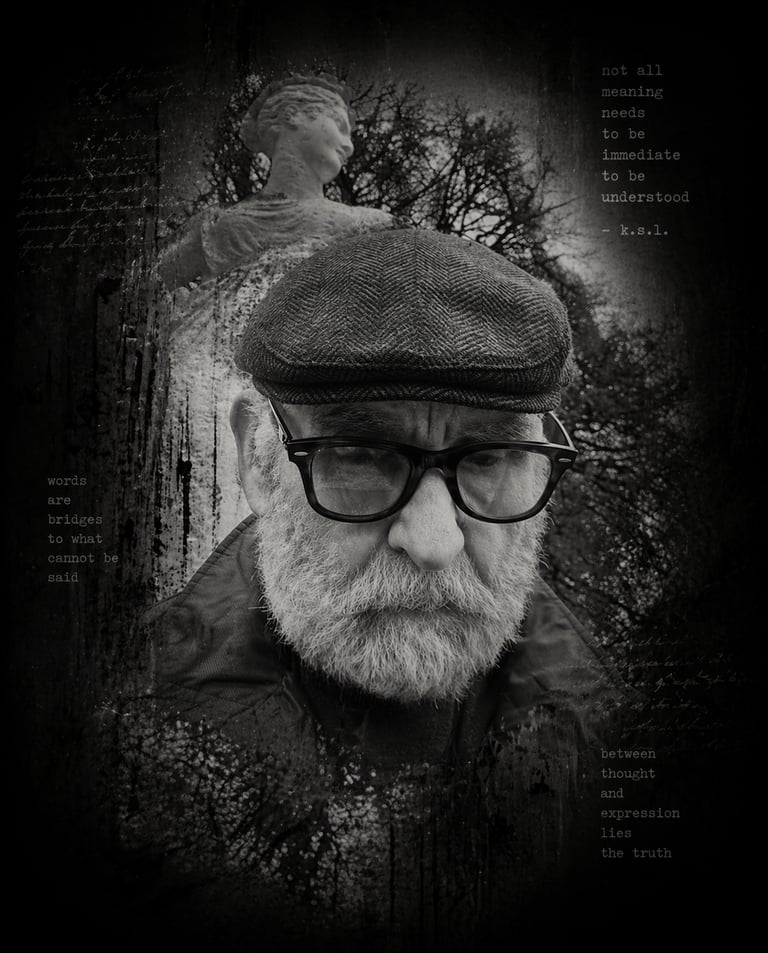
Lapham maintains a minimal public persona, allowing the work to stand without explanation or narrative framing. This restraint is deliberate. The poems are not intended to instruct or resolve, but to remain open—objects of thought rather than conclusions.
In this way, the work occupies a space between literature and visual composition. It is as much about how language is seen and felt as it is about what it says.
Subliminal poetry does not seek to be understood all at once.
It is designed to be returned to—
and to change slightly each time it is encountered.
Work Ethic
Years spent crafting subtle poetry, each piece a quiet ember glowing in the charcoal shadows.
Focus
Quiet, Intentional
Every word placed with care.

Subtle Glow
Experience. With our intuitive design and user-friendly interface, your website will captivate visitors. 2